The pay-to-rank boom: the boards where first place is for sale
In under a week a dozen sites appeared where position is decided by whoever paid the most. What they are, how much they actually move, and what a company is buying when it shows up on one.
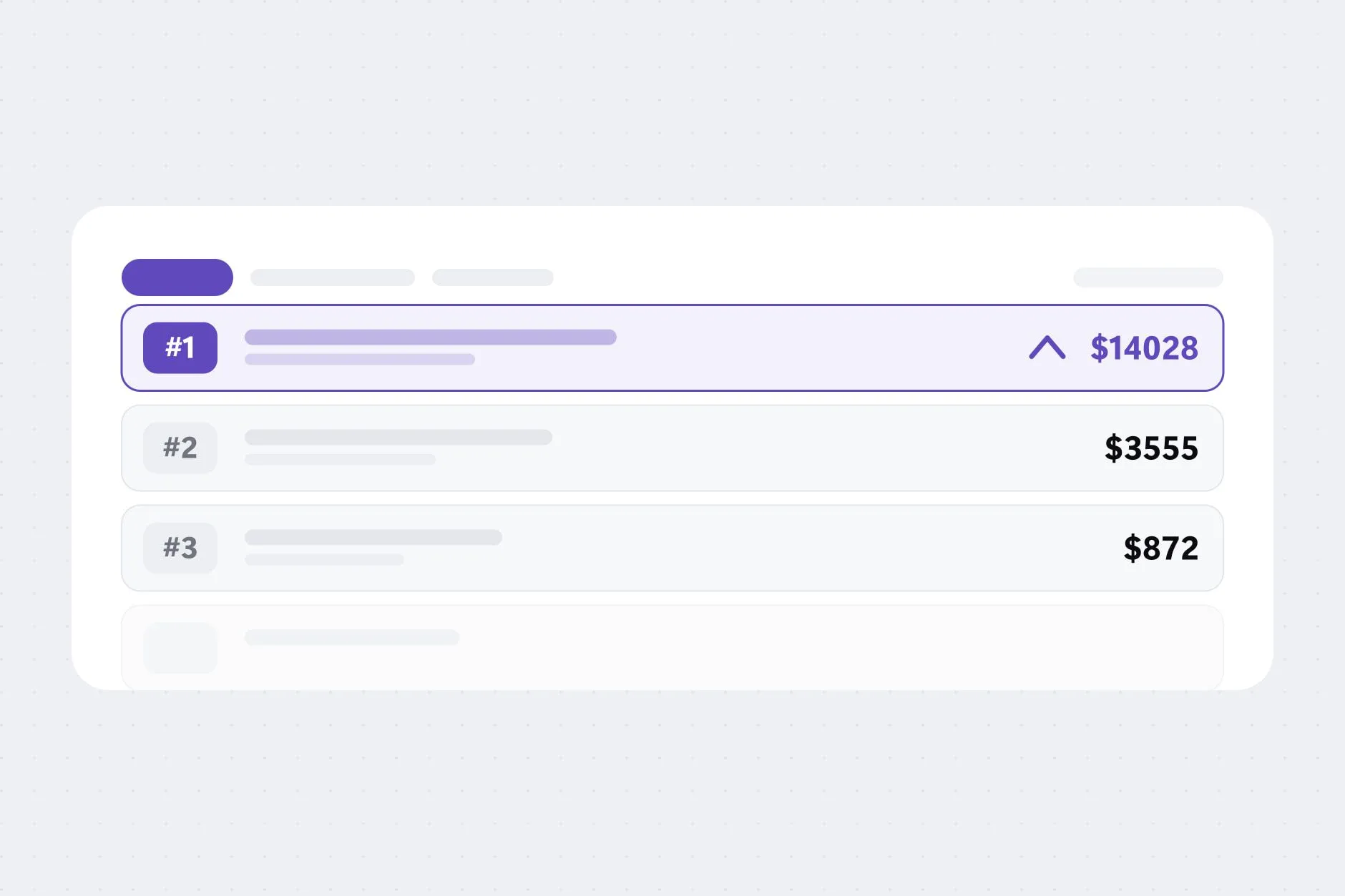
A few days ago a site appeared that is, literally, one list. Every row has a logo, a name, a two-line description and a link. The order is not decided by an algorithm, by an editor, or by anyone’s votes: it is decided by how much money each one paid.
It is called outbid.lol and a German developer wrote it in a three-hour session. Four days later it had passed a million visits and spawned dozens of imitators; there is even an Argentine equivalent.
It is worth a close look, because underneath the joke there is a new and unusually honest advertising format — and one expensive misunderstanding about what is being bought.
How it works
The mechanic fits in one sentence: the ranking is the money.
On outbid.lol you enter your product URL, pick a category and name an amount. That amount is your height on the list. If someone wants to pass you, they pay a dollar more and push you down; you can climb back by paying only the difference. All of it happens in the open: the page shows how many people are connected right now, how many clicks each row received, and what every position cost.
As of writing, the board reports 1,241,868 visits since launch and 868 people watching. The site has already changed shape once: alongside the all-time ranking there are now daily boards per category — AI, SEO, developer tools, marketing — where “rank is what you spent in the last 24 hours” and a new spot starts at five dollars.
The Argentine equivalent is lugarcito.online, built by a developer who signs as @agustinhooks_. Same idea, in pesos and through Mercado Pago: 73 spots, first place going for $310,130 ARS, and a tagline that says it all — “yours until someone pays more”. There is no software at the top: there is a property developer, a custom football shirt shop, an Argentine horror game and a sticker seller.
Then there is the counter-model. topclick.app is the same list with the rule inverted: money is useless there and you climb on clicks alone. “Click your way to #1”, it says. No bids, no budgets.
In between came an avalanche of variants, all launched the same week: a reverse auction where the lowest unique bid wins (lowbid.lol), 100-spot boards where a position loses 5% of its value per day (lastspot.lol), a world map where you buy countries (warmap.lol), head-to-head duels decided by visitors (pitchpit.lol), and several dozen more nobody is counting any more.
The numbers, with the caveat up front
Almost every figure in circulation is published by the site itself or by its author, so read them as what they are: unaudited claims.
With that said, here is the order of magnitude. Day one was reported at around $21,500 in revenue. By day three, roughly $139,000. The top bid climbed past $13,000. There was a six-figure acquisition offer, which the author turned down. Some products that held the top spots reported thousands of clicks.
That last figure is the hardest to believe and the most important one. The board’s click counters appear to reset hourly and do not always reconcile with the site’s own reported traffic. A click count published by the same party charging you for the spot is not a metric — it is sales material.
Why it took off
Three reasons, and none of them are technical.
The transparency is the product. Everyone knows digital advertising is an auction; what you never see is the price. Here the price is printed next to the position. That turns a media buy into something you can watch like a sport.
Displacement happens live. Losing your spot is a notification, a reason to come back and a reason to pay again. It is exactly a game mechanic, applied to a directory.
The audience is the same crowd that pays. The people watching the board are founders and marketers. So are the people buying spots. During the novelty window, the ad reaches someone who looks a lot like the person who placed it.
That third reason is also why the clones went nowhere. Forty identical boards split the same attention, and by board number forty the curve is flat. The format is reproducible in an afternoon; the audience is not.
What a company is actually buying
A spot on these lists is an ad. It is not press, not a review and not a recommendation — lugarcito says so in its own footer: “nothing that appears here has been reviewed or recommended by Lugarcito, and buying a spot guarantees no result”.
As an ad, it has one peculiarity: the inventory is novelty. A viral board concentrates nearly all of its traffic in the first few days and then goes quiet. Get in early and you buy cheap visits; get in during week three and you pay an inflated price for an audience that has already left. And because the price rises with bidding while traffic falls with time, cost per visit gets worse from both ends at once.
Then there is the usual question: who is doing the clicking. If you sell developer tools, a board full of developers is a reasonable channel. If you implement systems for a distributor or a clinic, the outbid.lol crowd is not remotely your buyer. Lugarcito is a different case: the audience is local and mixed, closer to a street market than to a technical directory.
None of this gets settled by looking at the board’s counter. It gets settled by tagging the link and watching what happens on your side. If you cannot tell where each enquiry from this week came from, the problem is not the ranking: it is that your commercial process is not being recorded anywhere.
What it is not: SEO
Here is the expensive mistake. Several of these sites are sold, explicitly or by implication, as a way to improve search rankings. They are not, and in the worst case they are the opposite.
Google’s spam policy is specific about it: “buying or selling links for ranking purposes” is a violation, and that includes “exchanging money for links, or posts that contain links”. Buying is acceptable only if the link carries a rel="sponsored" or rel="nofollow" attribute, which is how you declare that it passes no ranking credit.
A board that publishes the price of each link right next to the link is, to a pattern detector, the textbook case. Add that nearly all of these domains were registered days ago and carry no authority of their own, and the balance is clear: if the link is nofollow, it does nothing for your rankings; if it is dofollow, it adds risk.
Buy a spot as advertising, if the numbers work. Do not buy it as an SEO strategy.
If you want to try it anyway
It is cheap and it can be fun. Four rules to make it measurable as well:
- Tag the link. Your own campaign parameter in the URL, a different one per site. Without it you will never separate that traffic from anything else.
- Measure real cost per visit, counting the ones that reached your page, not the ones the board claims.
- Set a ceiling before you enter. The mechanic is designed to make you pay again when you get pushed down. Decide in advance what that game is worth and do not revisit the number with your pride up.
- Check whether the link is still alive after thirty days. Half of these sites will not exist in three months.
In short
The pay-to-rank boom is a small, transparent, short-lived advertising format. As a product experiment it is remarkable: one list, one payment button, no algorithm, built in an afternoon and past a million visits in four days.
As a channel for a company, it is an ad with the price on display and an early expiry date. It can be worth it if your buyer is part of that audience, if you measure on your own side, and if the amount fits in your budget for trying things.
What it is not, under any reading, is an SEO strategy. And if the argument for going in is “so people see us”, the boring part is worth solving first: knowing where each enquiry came from and what happens to it afterwards.
Sources: sites consulted on 23 August 2026; revenue and traffic figures as reported by the sites and their authors, without independent verification; Google Search spam policies, link spam section.