Live Nation announces 24/7 support with Agentforce
Live Nation is expanding Agentforce after its BottleRock pilot. What Salesforce actually reported, and how to measure an AI customer-support agent in production.
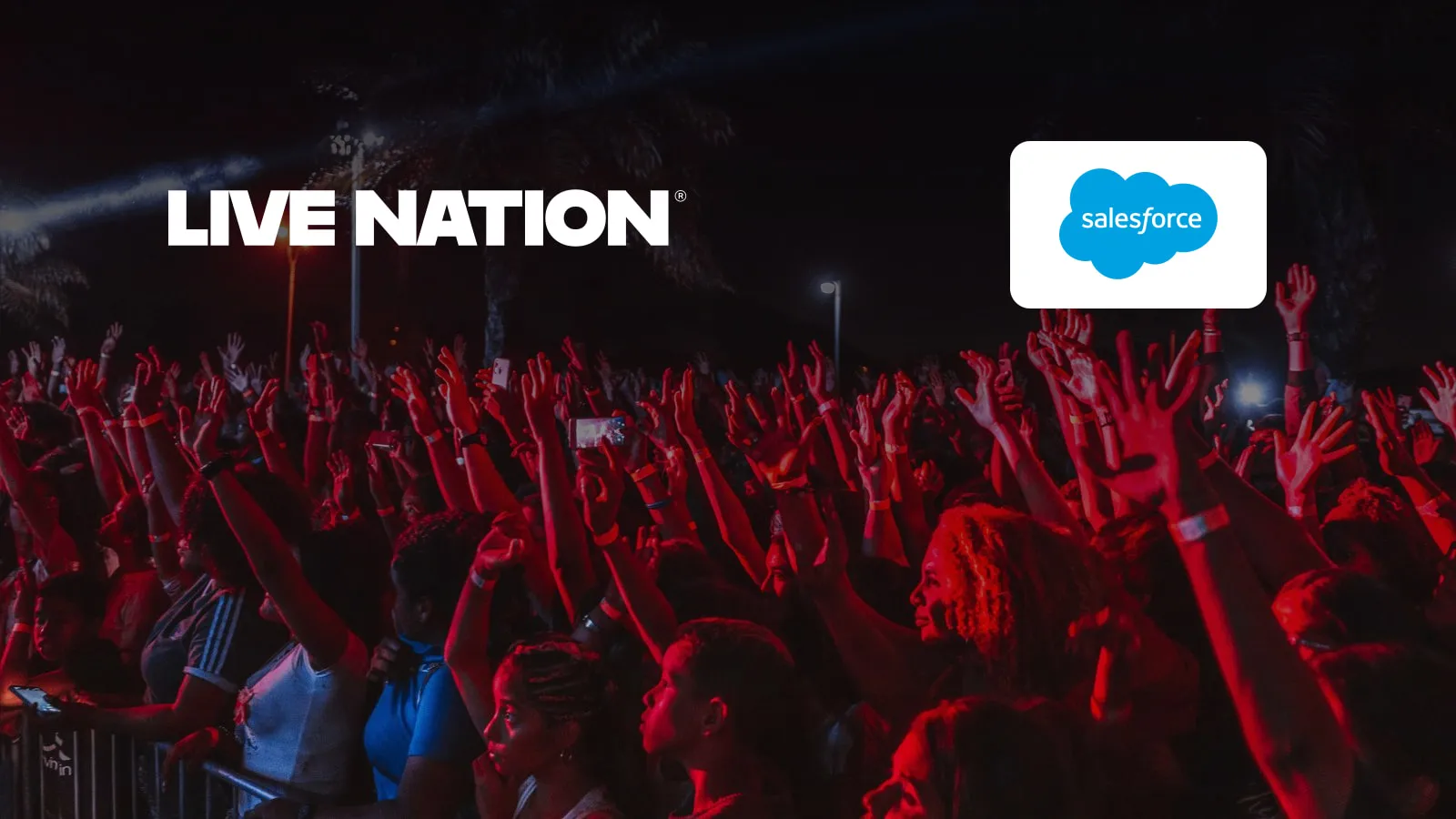
Live Nation Entertainment announced an expansion of Agentforce to provide information and support to fans at its concert venues across the United States. The Salesforce announcement, dated September 16, 2026, follows a pilot at BottleRock Napa Valley.
The notable part is not that a festival added a conversational assistant. It is the move from a focused experiment — helping people before and during one event — to a system intended to answer questions across many venues, around the clock. That transition requires more than a convincing demo: correct venue context, a reliable human handoff, and evidence that service is improving.
What the BottleRock Agentforce pilot did
At BottleRock 2026, Live Nation introduced Melody, a guide embedded in the festival app. Fans could ask about artist set times, stage locations, and recommendations related to their visit. The agent retained conversation context to handle follow-up questions.
Salesforce says Melody went from concept to production in under 30 days. During the 12-day period leading up to the festival, it recorded more than 37,000 fan interactions and 17,000 customer-service sessions. The company also reports that 85% of users found the answer they needed within three responses.
Those are vendor-reported figures from this particular deployment, not a financial-savings calculation or a result every organisation should expect. They do, however, describe a pilot used by real customers at a scale large enough to reveal patterns in demand.
From a festival guide to Venue Agent
The next stage is Venue Agent. According to Salesforce, it answers questions on venue websites about parking, prohibited items, accessibility, and door times. Live Nation uses one agent system backed by Service Cloud and Data Cloud to retrieve venue-specific information rather than building a separate bot for every location.
When a fan asks for a person, or the answer falls outside the available knowledge, the conversation is routed through Slack to the team monitoring the agents. Salesforce says 95% of questions Venue Agent currently handles are answered without a team-member handoff. The announcement does not give a cost per case, subsequent satisfaction figures, or a count of venues already covered. It is therefore more accurate to describe an announced expansion than to claim a completed rollout to every US venue.
Why this case matters to other businesses
Customer support is a sensible first use case for agents because the work has observable boundaries. There are recurring questions, identifiable information sources, periods of peak demand, and a clear exit when the agent cannot resolve the issue.
A well-designed flow might be:
- Receive and classify the question.
- Identify the relevant event, customer, or product.
- Retrieve current information from a trusted source.
- Answer or perform an authorised action.
- Escalate when context is missing or an exception appears.
- Record the outcome so the process can improve.
That flow is our operational interpretation, not a complete technical description of Live Nation’s implementation. The distinction matters. Copying a chat interface does not reproduce the business rules, data sources, or people handling exceptional cases.
As we explain in how to implement AI with existing systems, data integration and operating design determine much of the outcome. An agent that answers quickly from an expired policy can increase the team’s workload instead of reducing it.
How to measure a pilot before scaling it
The business question should not be “How many conversations did the agent have?” It should be what changed compared with the previous support process. Establish a baseline before launch, then compare by question type:
| Metric | What it reveals |
|---|---|
| Time to a useful answer | Whether the customer experience improved |
| Resolution without human intervention | How much repetitive volume was genuinely absorbed |
| Correct escalations | Whether exceptions reach people with enough context |
| Corrected or reopened answers | Errors a resolution rate may conceal |
| Team effort per case | Whether work was removed or merely displaced |
Safety criteria matter too: when the agent should abstain, which data it can access, and which actions need approval. The difference between a real agent and automation dressed up as one is visible in those controls and in its ability to operate within a process, not in the tone of its replies.
The opportunity for service teams
Live Nation illustrates a reasonable path: start with a bounded use case, observe real questions, then extend the system to more customer touchpoints. It does not prove every company will achieve the same figures, and it does not publish a verified financial return. It does show why the useful unit is not a generic chatbot. It is a support flow connected to specific information, a reliable escalation route, and evidence for continuous improvement.
For a company considering its first agent, that is more actionable than promising “AI for everything.” Choose one common request, document who resolves it today, measure before and after, and only then add channels or actions. The objective is not to remove every human interaction. It is to reserve people for the situations where they add the most value.
Primary source reviewed on September 17, 2026: the official Salesforce and Live Nation announcement. The quoted metrics are Salesforce’s figures; on their own, they do not establish verified financial ROI.